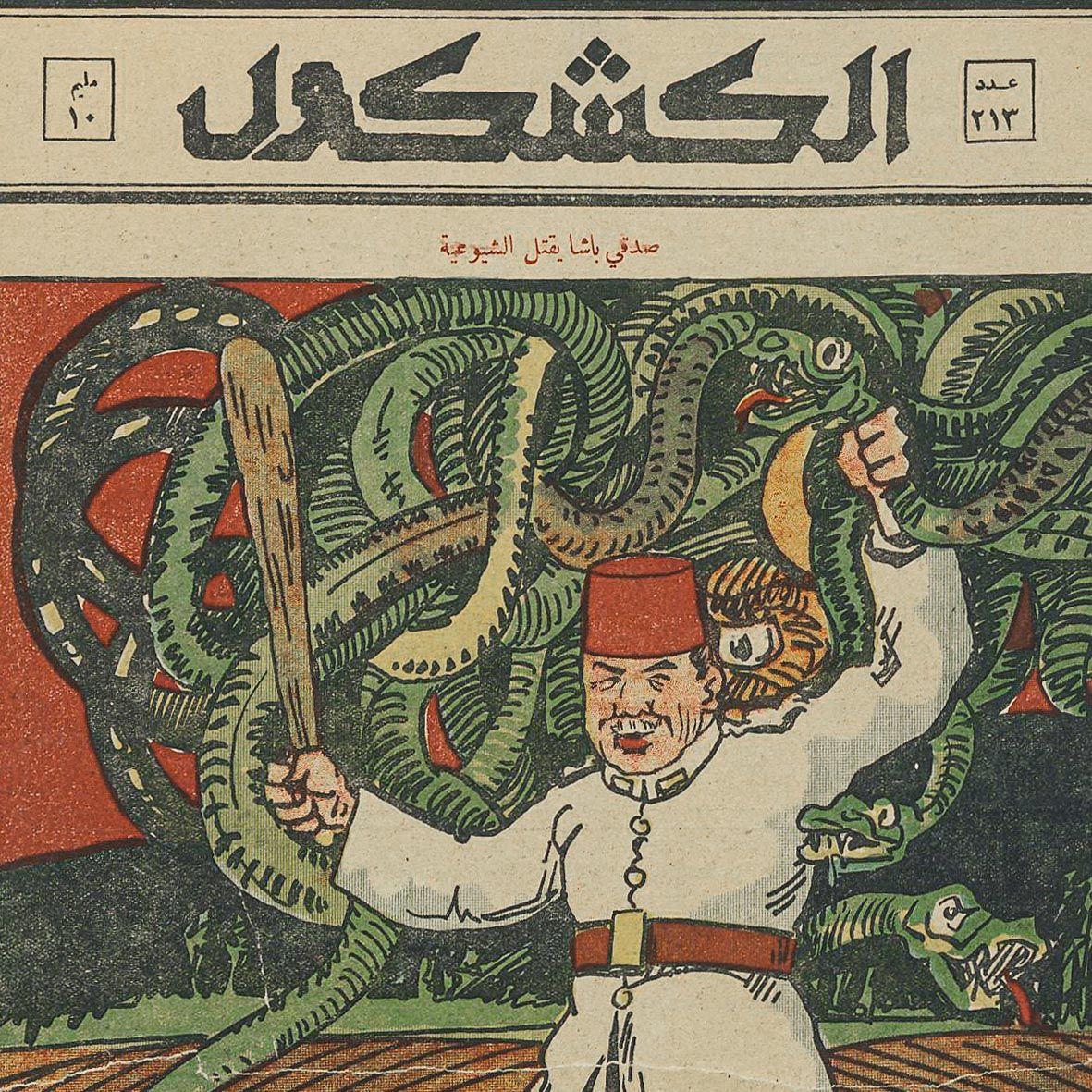
Alexander Saroukhan: The Pioneer of Political Caricature in Egypt
Alexander Saroukhan was born on October 1, 1898, in the town of Ardanoush, part of the Batumi district in Georgia, Caucasus, which was then part of the Russian Empire. He spent his early years, from age two to eleven, in the city of Batum with his family, where he received his primary education at the Gymnasium (Russian primary school), together with his younger brother, Levon. In 1909, they moved to Istanbul (Constantinople) and enrolled in the Viennese High School of the Mekhitarist Fathers in Pangaltı.
During World War I, Saroukhan and his brother Levon remained as boarders at the Mekhitarist Fathers’ school while their family returned to Ardanoush. Their stay at the school saved them from the Armenian Genocide perpetrated by the Turks, as the high school was under the protection of Austria, then an ally of the Ottoman Empire.
In 1922, amid renewed threats against the Armenians of Istanbul, Saroukhan and his brother joined their uncle, Arakel Saroukhan, in Belgium, where he was a director at the Mantashev Oil Company. From that point on, they were permanently separated from their parents and sisters.
Recognizing his nephew’s artistic talent, their uncle sent him to Vienna to study fine arts and lithography, where he completed his studies in two years.
In 1924, following a proposal from an Egyptian student studying printing at the same institute to work as a cartoonist for a newspaper he intended to publish, Saroukhan moved to Cairo. However, the newspaper ceased publication after only two issues. To support himself, he worked as an art teacher at the Kalousdian and Berberian schools.
In January 1925, he realized his dream by publishing the satirical magazine Armenian Cinema, which ran for fifty issues.

In 1927, at the invitation of Mohamed El Tabei, he joined Rose El Youssef as a political cartoonist. Later, in 1934, he joined Akher Sa’a, also founded by El Tabei. This marked the beginning of his long career in Egyptian media. In 1946, he joined Akhbar El Yom, where he worked alongside the renowned cartoonist Mohamed Abdel Moneim Rakha until his death on January 1, 1977. One of his most notable creations is the character Al-Masri Effendi, who came to represent public opinion and the common man.
He participated in group exhibitions and held solo exhibitions in Egypt, Armenia, Canada, the United States, Syria, Lebanon, and France. He also collaborated with numerous Arab, French, and English newspapers and magazines, and his works were published in many Armenian newspapers.

Among his most famous works is the book Cette Guerre (This War), published after World War II in 1945 in French and English, reflecting the events of the war through caricature. The book was based on The Political Year 1938, an album of cartoons published in French in Cairo in 1939 by La Bourse égyptienne. A second edition of Cette Guerre (This War) was published in 2025.
Saroukhan was also the owner and director of La Caravane, a weekly magazine presenting social, satirical, and political subjects, mainly addressing World War II through articles and cartoons. La Caravane, which ran for 162 issues, was published in Cairo in French from December 1938 to January 1942 and was distributed in Egypt and abroad.
He also authored illustrated books such as Look at Your Words, Kherfooni, and We Through Our Glasses (in Armenian), in addition to satirical plays including We Do Not Know Armenian, among others. He also enriched Enger Panchouni by the writer Yervant Odian and The Honorable Beggars by Hagop Baronian with his insightful caricatures.
In 1960, he received the Cartoon for Peace Award from the People-to-People Committee in the United States.
Saroukhan remained a defender of the just causes of the Armenian people and an active member of several Armenian associations, alongside his cultural and media activities. He was granted Egyptian citizenship by President Gamal Abdel Nasser in October 1954.
A short documentary on Saroukhan, directed by Moataz Ragheb in 2012, was produced in Egypt by the Ministry of Culture. Saroukhan’s works are held in several museums and collections, including the National Gallery of Armenia and the Charents Museum of Literature and Arts in Yerevan, Armenia; the library and museum of the Mekhitarist Monastery in Vienna, Austria; the Mekhitarist Monastery on Saint Lazarus Island in Venice, Italy; the Mahmoud Khalil Museum in Giza, Egypt; the Fayoum Caricature Museum in Egypt; and the Baron Empain Palace in Heliopolis, Cairo.

In 2006, a street in the New Nozha district of Cairo was named after Saroukhan as the Pioneer of Political Caricature in Egypt, pursuant to a Cairo Governor’s decree. In 2019, a plaque bearing his name was installed at the entrance of his house in Heliopolis as part of the “Lived Here” initiative by the National Organization for Urban Harmony and the Cairo Governorate, in recognition of eminent figures in Egypt.
Text by: Silva Saroukhan